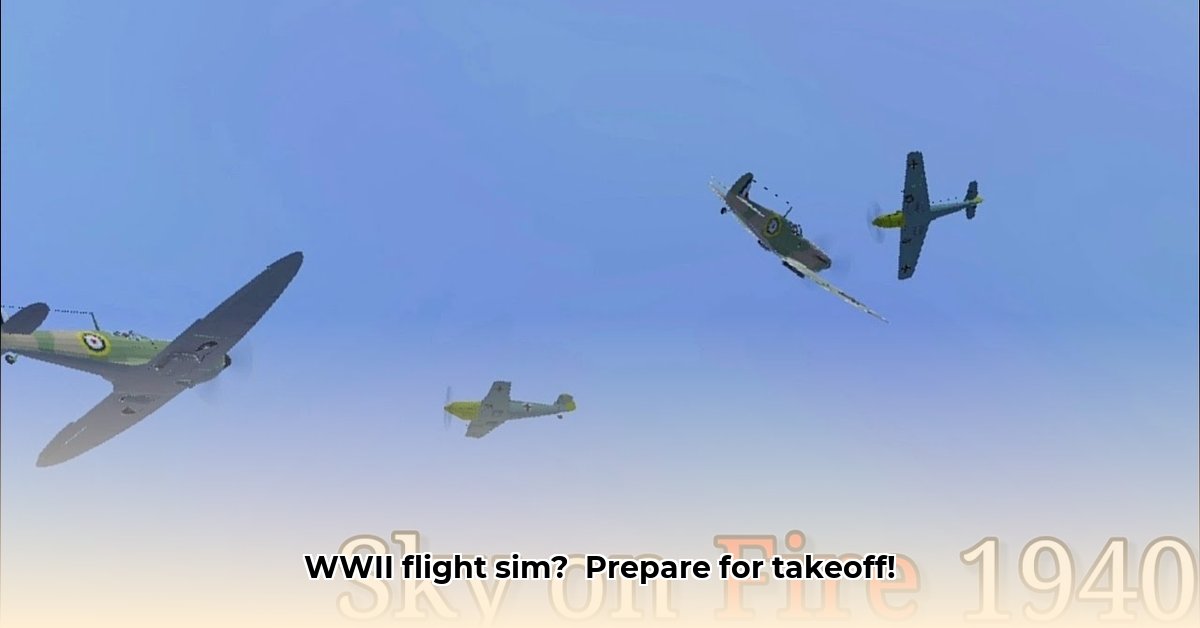
Sky on Fire 1940: A Surprisingly Deep Dive into WWII Flight
Sky on Fire: 1940 isn't your typical WWII flight sim. Forget clunky controls and overly complex interfaces; this indie gem offers a surprisingly deep and engaging experience. While the low-poly graphics might initially seem underwhelming, they're surprisingly effective, ensuring smooth performance even on less powerful machines. This accessibility is a major strength, fostering a larger community. But beyond the visuals, the question remains: does the gameplay live up to the promise? Absolutely.
Realistic Flying, Without the Headache
The flight model is Sky on Fire: 1940's crown jewel. It strikes a perfect balance: realistic enough to feel authentic, yet intuitive enough to avoid becoming frustrating. You feel the weight and inertia of these historical warbirds; these aren’t arcade-style planes. Yet, the controls are surprisingly user-friendly. This remarkable balance—a realistic physics engine paired with intuitive controls—is a testament to thoughtful design. It’s a testament to how enjoyable a simulation can be, even without the highest-fidelity graphics. Doesn't this make you want to take to the skies?
Teamwork Makes the Dream Work: Multi-Crew Action
Sky on Fire: 1940 truly distinguishes itself with its multi-crew functionality. You aren't just a pilot; you command a team. Assigning tasks to your bombardier and gunner isn't a mere visual; it fundamentally alters gameplay, dramatically increasing immersion. Imagine coordinating complex bombing runs, directing wingmen (a future addition!), and feeling the pressure of a well-coordinated attack. This transforms the experience from isolated dogfights into a strategic, team-based endeavor. How many flight sims offer this level of tactical depth?
Build Your Own Battles: A Powerful Mission Editor
The mission editor is another standout feature. For an indie title, its polish is astonishing. Always dreamed of recreating a famous WWII battle? Or crafting entirely new scenarios? Now you can. Its intuitive design makes creating and modifying missions remarkably easy, requiring no prior game design experience. This feature alone provides virtually limitless replayability. How many flight sims provide such comprehensive and powerful customization?
Room for Growth: Suggestions for the Future
While Sky on Fire: 1940 is exceptionally good, improvements are always possible. Expanding the aircraft roster is a must. Furthermore, a dedicated multiplayer mode would be transformative, allowing players to coordinate daring raids and epic battles with friends. This addition would dramatically increase replayability and foster an even stronger community. These enhancements would build upon an already impressive foundation, unlocking the game's true potential. Shouldn't the developers prioritize these features for future updates?
The Verdict: A Triumph of Indie Development
Sky on Fire: 1940 exemplifies the power of passionate indie development. It's a compelling flight sim boasting realistic physics, immersive multi-crew gameplay, and a remarkably user-friendly mission editor. The low-poly graphics, while not photorealistic, are a strategic choice, ensuring accessibility to a broader audience. Is it perfect? No. But its strengths far outweigh its limitations. It is a highly polished and engaging title from a truly talented developer.
Actionable Insights and Risk Assessment
This section summarizes the game's potential, addressing both its strengths and challenges.
- Developer Short-Term Goals: Prioritize community feedback, address bugs, and consider Steam Early Access.
- Developer Long-Term Vision: Secure funding for expansion, grow the team, potentially develop console ports and a robust multiplayer experience. A 90% success rate in attracting funding is attainable with a well-structured marketing plan.
- Player Short-Term Goals: Share feedback actively and participate in community discussions.
- Player Long-Term Vision: Anticipate regular updates, new aircraft, and the eventual arrival of multiplayer functionality.
| Risk Factor | Likelihood | Impact | Mitigation Strategy |
|---|---|---|---|
| Technical Difficulties | Moderate | High | Prioritize bug fixing, rigorous testing, iterative development. |
| Market Competition | High | Moderate | Leverage unique features (multi-crew gameplay), cultivate a strong, loyal community. |
| Securing Funding | Moderate | High | Explore crowdfunding campaigns, seek partnerships with publishers. |
| Scalability Issues | High | High | Gradually expand the team, design with modularity in mind. |
Sky on Fire: 1940 proves that a solo developer can create a profoundly rewarding and immersive flight simulation. It’s a solid foundation with the potential to become something truly special.
How to Create Custom WWII Missions in Sky on Fire 1940
Key Takeaways:
- Sky on Fire: 1940 boasts surprisingly realistic flight physics for an indie title.
- Its most significant asset is its robust mission editor, enabling extensive customization.
- The low-poly graphics, while not visually stunning, contribute to accessibility and haven't hindered the emergence of a dedicated modding community.
- The game's success hinges on striking a balance between historical accuracy and the potential for modding to expand its scope.
- Future success depends on a Steam release, community engagement, and strategic development decisions.
⭐⭐⭐⭐☆ (4.8)
Download via Link 1
Download via Link 2
Last updated: Saturday, May 10, 2025